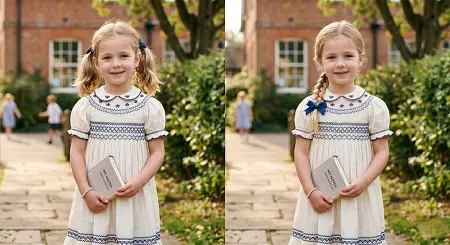
I still remember my daughter’s second-grade picture day. I’d spent the better part of a weekend finding the perfect dress — a soft ivory smocked top with navy embroidery, exactly the kind of piece that photographs beautifully. The morning of, I wrestled her hair into a ponytail with whatever elastic I could find, announced it was “good enough,” and rushed her out the door. When the photos came back six weeks later, the dress was everything I’d hoped for. The hair told a completely different story.
I still remember my daughter’s second-grade picture day. I’d spent the better part of a weekend finding the perfect dress — a soft ivory smocked top with navy embroidery, exactly the kind of piece that photographs beautifully. The morning of, I wrestled her hair into a ponytail with whatever elastic I could find, announced it was “good enough,” and rushed her out the door. When the photos came back six weeks later, the dress was everything I’d hoped for. The hair told a completely different story.
That was the moment I stopped treating the outfit and the hair as two separate decisions. Cleverly pairing children’s outfits with hairstyles — as one intentional choice rather than an outfit decision followed by a hair afterthought — changes the entire result. Once you start seeing them as a team, you can’t unsee it.
Most of us put real thought into kids’ clothing — weighing colors, considering the occasion, checking whether something still fits. But pairing children’s outfits with hairstyles rarely gets that same deliberate attention, and the gap shows more than we realize.
Hair frames the face and sets the formality register of the entire look. It shapes the visual silhouette in ways we process before we consciously notice them. Picture a flowy floral dress worn with tangled, half-fallen-out hair versus that same dress with two neat braids and coordinating ribbon ties. The dress didn’t change — the presentation did. Entirely.
There’s a confidence dimension here that’s easy to underestimate. Research from child development experts at Parents.com consistently shows that children who feel good about how they look engage more readily with peers, carry themselves with more assurance, and are more willing to step into unfamiliar situations. A pulled-together look — hair fully included — is one of the simplest things we can do to support that confidence on an ordinary Tuesday.
Cleverly pairing children’s outfits with hairstyles takes less time than you think. It just takes intention, and a few guiding principles to make the decisions faster.
If there’s a single rule I wish I’d learned earlier, it’s this: look at the neckline before you touch the hair. No matter the age, style, season, or occasion, the neckline is almost always the most reliable guide for pairing a hairstyle with a kids’ outfit — and once you internalize it, most mornings make themselves.
Turtlenecks, mandarin collars, crew necks, and button-up shirts all work best with hair swept up or pulled back. A neat bun, two puffs, a half-up style, or braids worn away from the neck keep the silhouette clean and let the neckline read clearly. Hair worn loosely down over a high collar adds visual weight exactly where you don’t want it — and in my experience, it makes even a well-fitted top look a size too small.
Scoop necks, V-necks, wide-set straps, and sundresses are the most forgiving. Loose waves, a low ponytail, or hair worn completely down all complement these styles naturally. The openness at the collar creates its own visual balance, and softer, more relaxed hair echoes that effortlessly.
Lace collars, Peter Pan collars, embroidered necklines, ruffled trim — these details are the point of the garment. Keep the hair away from them. A sleek updo or a low ponytail lets the neckline read clearly instead of disappearing under a layer of loose hair. I once watched a spectacular Peter Pan collar vanish entirely beneath a voluminous blowout. The collar had no chance.
This neckline principle is the foundation of cleverly pairing children’s outfits with hairstyles, and everything else builds from here.
Jeans, graphic tees, joggers, play sets, and anything built to survive a full school day calls for relaxed, low-maintenance hair. A ponytail, pigtails, a puff, a low bun, or hair worn naturally down with a simple headband — these styles feel right because they’re built for the same life the outfit is built for.
My personal rule: if the outfit can go from classroom to playground without a second thought, the hair needs to be able to do the same.
A smocked top, a collared shirt with chinos, a matching set, or a midi skirt with a tucked blouse calls for a hairstyle that’s a clear step above the everyday ponytail — without requiring a YouTube tutorial. This is where braids earn their keep. A single French braid, two side braids, or a braided half-up style adds genuine polish without tipping into overdone. A structured bow clip or a fabric headband works equally well and takes under a minute once you’ve built the muscle memory.
For recitals, family portraits, weddings, and holiday gatherings, the clothing tends to be considered and detailed — velvet, tulle, formal cuts, embroidered accents. The hair should meet that same level of intention. Elegant updos, tight buns, pinned curls, or a formal braided crown all complement thoughtfully designed special-occasion pieces for children.
One thing I’ve learned the hard way: when the outfit is heavily embellished — ruffles, beading, intricate patterns — keep the hair clean and minimal. Let the garment be the statement. When the outfit is elegant but understated, the hairstyle has more room to do the talking.
This is the dimension of cleverly pairing children’s outfits with hairstyles that most people overlook — and it’s where so much of the final result actually lives. The bow, clip, scrunchie, or headband you reach for is a styling choice. It adds color, texture, and visual weight to the overall look. Pull from the outfit’s color palette, not against it. If your child is wearing a dusty sage dress, a cream or muted green bow ties the look together intentionally. If the outfit has multiple colors, reach for a secondary tone rather than the dominant one — it creates a layered, curated effect rather than something that reads as overly matchy. Simplify when the outfit is already doing a lot. Bold prints, large florals, bright stripes, and busy patterns don’t need accessory competition. One solid-colored elastic or a small plain clip is exactly enough. Stacking a patterned headband on top of a patterned outfit almost always reads as chaotic rather than considered. Stock neutral accessories and protect your mornings. White, cream, black, and navy accessories pair with virtually everything. According to expert stylists at Allure, a strong neutral accessory kit is the most practical investment in any child’s styling routine — because on the mornings you don’t have time to think, the decision is already made for you.
One of the most consistent mistakes I see in pairing children’s outfits with hairstyles is choosing a look that fights the hair’s natural texture. A style that’s stunning on fine, straight hair can be genuinely impractical on thick, coily hair — and forcing it wastes time and leaves everyone frustrated before 8 a.m.
Holds sleek styles well: smooth low ponytails, flat braids, polished buns. These look intentional and maintain shape throughout the day without much product. Avoid styles that depend on volume unless you’re committed to creating it.
Is genuinely stunning worn naturally — and pairs especially well with flowy, romantic, or textured clothing. A defined puff, two puffs, or a thoughtful wash-and-go with a coordinated accessory can be every bit as polished as an elaborate updo when the rest of the look is assembled with care. I love browsing the Hapa Garments collection specifically for flowy, softly structured pieces that let natural hair be the star it is.
Naturally directs visual attention downward, toward the outfit — which is actually a styling advantage. Let the clothing carry the look. A small clip-back or a simple side pin adds enough intention without overwhelming the clean simplicity that makes short hair so striking.
Sometimes the most useful thing is a concrete example. These are the combinations I come back to again and again — because they work, reliably, across occasions and ages:
All of this is only useful if it’s actually executable — not just on a slow Saturday morning, but on a real Wednesday when someone can’t find their shoes and you’re already three minutes behind schedule. Here is how I’ve made cleverly pairing children’s outfits with hairstyles a daily habit rather than a special-occasion luxury.Decide the night before. Lay out the outfit and commit to a hairstyle at the same time. It takes five minutes and eliminates a decision entirely the next morning. If tomorrow is a collared shirt and chinos, you already know the hair goes up. Done.Build a small, reliable repertoire and own it. You don’t need twenty styles. You need four that you can execute on autopilot: a ponytail, two braids, a half-up, and a bun will handle nearly every situation in a given week.Organize accessories by color family. A small divided tray near the mirror — neutrals together, brights together, special-occasion pieces separate — means grabbing the right bow or clip is automatic rather than frantic.
Give your child a real choice. Children who feel some ownership over how they look are more cooperative, more confident, and considerably more willing to sit still for hair. Offer two options — “the braids or the bun?” — rather than an open-ended question. Child development guidance from the American Academy of Pediatrics isclear that giving children age-appropriate choices in daily routines supports their growing sense of autonomy and self-expression. That’s a genuine developmental benefit that also happens to make your morning easier — which is a parenting win on two levels.