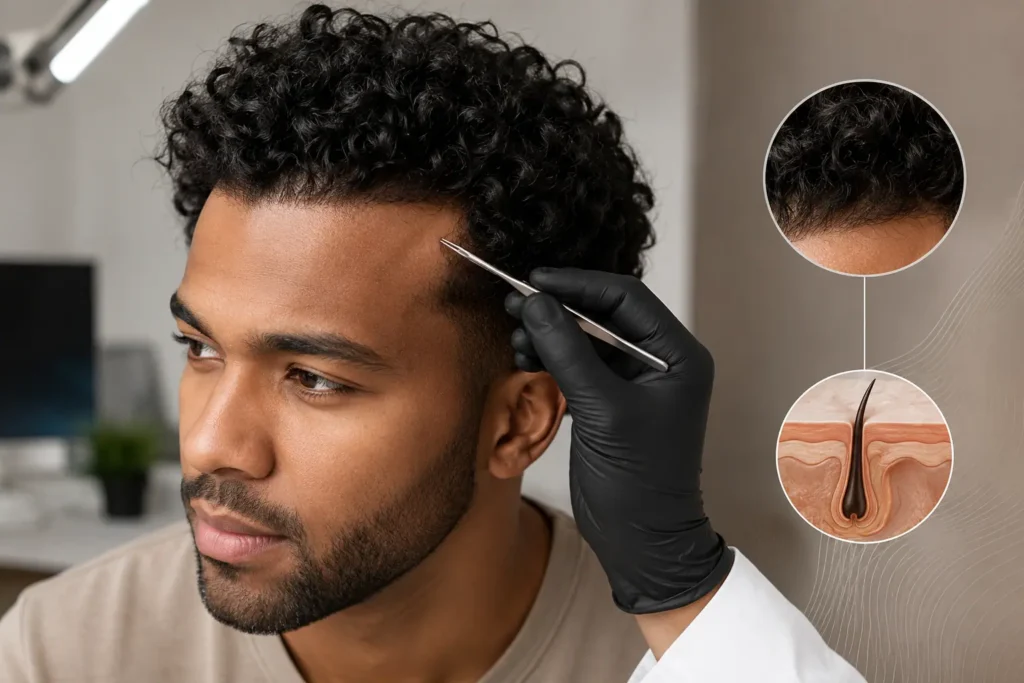
Yes. The key question is not simply, “Can you get a hair transplant with curly hair?” but whether your hair loss pattern, scalp health, and available donor supply make you a suitable candidate. People with stable thinning and strong permanent hair at the back or sides of the scalp may qualify.
A clinical assessment should review:
Hair loss due to active inflammation or scarring alopecia may require medical control before surgery. A transplant moves follicles; it does not stop untreated loss around them. This is why a complete diagnosis matters before choosing a procedure.
The visible strand may curl above the skin, while curly hair follicles also bend below it. During follicular unit extraction (FUE), the surgeon must follow this hidden curve. A straight or poorly directed punch may cut across the root, damage the graft, or reduce the number of usable hair grafts. This does not mean textured hair produces worse results. Curly hair often provides greater visual coverage and may create the appearance of natural density with fewer grafts. The team must still avoid overharvesting. The chosen hair transplant technique should reflect curl tightness, follicle direction, skin characteristics, and punch control. Manual tools may offer more control, while robotic systems may not suit sharply curved roots.
The choice of hair transplant technique depends on follicle shape, the number of required grafts, hairstyle preferences, and tolerance for a linear scar.
A treatment plan starts with photographs, scalp examination, diagnosis, and an estimate of future thinning. The surgeon then maps the hairline and sets a safe graft limit. Planning should address:
During extraction and implantation, the surgical team must handle the grafts carefully and keep them properly hydrated. Placement should follow the natural direction, angle, and curl pattern of the existing hair. This helps transplanted hairs blend with the rest of the hair rather than grow in conflicting patterns.Hair transplant procedures should reflect styling habits. Short styles may make scars more important, while longer curls may shift attention to shape, volume, and flexibility.
In most cases, transplanted hair remains curly because its characteristics come from the original follicle, which usually continues producing a similar curl pattern, thickness, and color. The early texture of transplanted hairs may look different because new strands can initially appear fine, wiry, or uneven. These changes often settle as the growth cycle matures. The final appearance depends on follicle survival, placement direction, curl pattern, and how well the new strands blend with nearby hair. Surgery cannot guarantee a perfect match. Texture may change with age, hormones, medication, or scalp conditions, so the surgeon should explain these limits before treatment.
The initial recovery period may include redness, crusting, tightness, and mild swelling. Patients must follow washing and sleeping instructions to avoid disturbing the grafts. A practical timeline may include:
Tightly curled strands may appear fuller before all units mature because each curl creates more visual coverage. Final timing varies, so progress should be evaluated through standardized photographs rather than daily mirror checks.
The main risks include follicle transection, unnatural growth direction, limited hair growth, visible scarring, infection, shock loss, and overharvesting of the donor area. Poor planning can also create a dense front with inadequate supply to meet future losses. Be cautious if a clinic promises a fixed number of grafts or a guaranteed result without examining you. The safe number depends on scalp laxity, density, follicle grouping, curl pattern, and long-term loss. Transplants for curly textures should be planned by a team that can show comparable cases and explain why one method suits your anatomy. A personalized consultation should cover expected density, alternative treatments, surgical risks, cost considerations, and a long-term plan to preserve healthy hair.
Ask how often the surgeon performs hair transplants for curly hair and whether they personally complete the critical stages of the procedure. Review results from patients with a similar curl type, loss pattern, and skin tone. The consultation should clearly explain:
Natural-looking results depend on an accurate diagnosis, conservative harvesting, careful graft handling, and placement that follows the patient’s natural curl direction. Focus on the surgeon’s experience with textured follicles and the quality of the plan, not on a branded method or a large promised graft count.