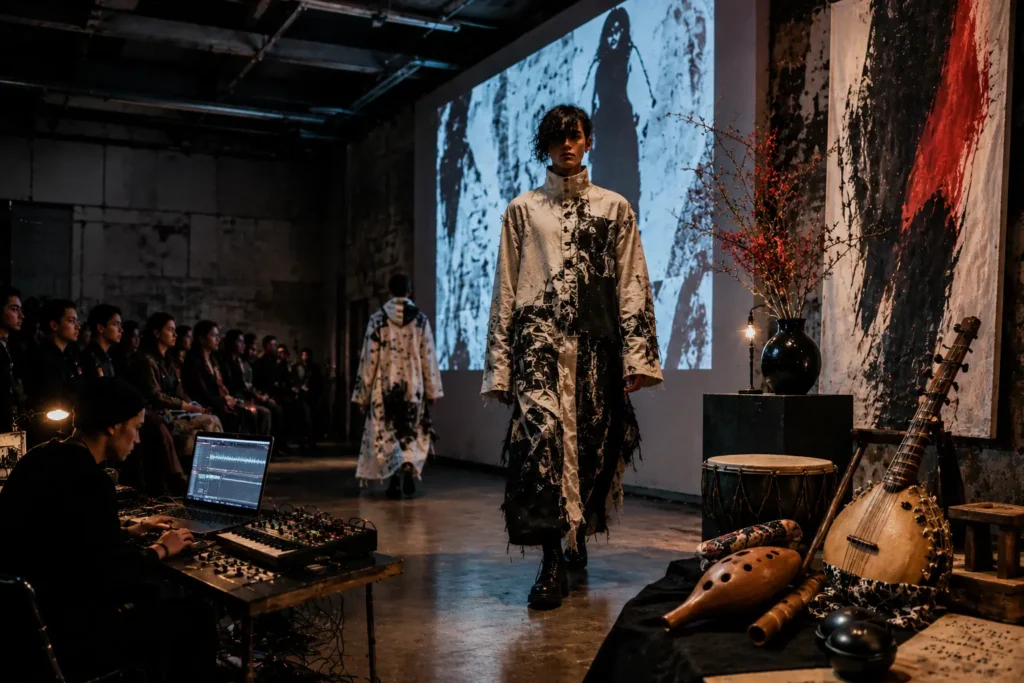
Something is shifting at the edges of fashion culture, and it isn’t happening on the main runways. A generation of designers, musicians, and visual artists has quietly stopped treating their disciplines as separate careers. For them, a collection isn’t a rack of garments — it’s a concept that arrives with an original score, a gallery installation, a short film, and a room full of people trying to figure out where the clothes end and the artwork begins. Call it the new creative underground. It has no single scene, no manifesto, and no central city. What it does have is a shared instinct: that the most interesting ideas in fashion, sound, and visual art now live in the space between them.
Not long ago, the creative world rewarded specialization. You were a designer, or a producer, or a photographer, and crossing over was treated as a side project at best and a dilution of your brand at worst. That logic has broken down. The artists driving culture forward today move fluidly between mediums because the tools finally let them. A designer can compose a soundscape on a laptop. A musician can direct a lookbook film on a phone with a rigged lens and a borrowed light. The barrier that once separated disciplines wasn’t creative — it was financial and technical, and both have collapsed. What replaced it is a more demanding standard. When anyone can make anything, the differentiator becomes coherence: whether the sound, the image, and the garment all feel like they came from the same mind. Independent collectives have figured this out faster than legacy houses, which is why so much of the genuinely new work is emerging from studios of three people rather than departments of thirty.
Ask most people to describe a fashion presentation and they’ll talk about silhouettes, casting, lighting. Almost nobody mentions the audio — which is exactly why it has become such fertile territory. Sound design is doing serious work in independent fashion right now. At pop-up exhibitions, ambient compositions shape how long people linger and how they physically move through a space. At small runway shows, an original score does what a licensed track never can: it tells you what the collection is about before a single garment reads clearly. In lookbook films, the audio is frequently carrying the emotional weight while the visuals stay deliberately restrained. The shift is from soundtrack to score. A soundtrack is borrowed — it brings someone else’s associations into your world. A score is built, and it belongs only to the thing it was made for. Independent labels have started commissioning music the same way they commission a print or a fabric treatment, as a material with its own properties rather than a finishing touch applied at the end.
This is where crossover really begins. Once a designer starts thinking about sound as a design material, they start asking the questions musicians ask. What does this texture feel like? What’s missing from the frequencies I keep hearing? And why does everything sound the same?
The honest answer to that last question is that most contemporary music is built from the same finite library of digital sounds. Software instruments and preset packs are excellent, widely available, and — precisely because they are widely available — increasingly interchangeable.Artists working at the fashion-art intersection have responded by going looking for sounds that resist that flattening. Field recordings turn up constantly: subway air, rain on a specific surface, the ambient hum of the neighborhood a collection was made in. So do acoustic instruments recorded badly on purpose, room tone left in, imperfections preserved rather than edited out. The most compelling work in this space tends to draw on global and traditional instrumentation. Not as decoration or borrowed exoticism, but because instruments developed over centuries in other musical traditions produce timbres that digital emulation genuinely struggles to reproduce. A struck metal idiophone, a bowed string with unfamiliar tuning, a clay wind instrument — these carry an acoustic complexity that reads as real to the ear even when the listener can’t name what they’re hearing.
For a collection built around ideas of place, memory, or migration, that texture does conceptual work no synthesizer patch can.
Put sound, image, and garment together with real intent and the output stops being a product launch. It becomes a world.This is the defining ambition of the current underground. A drop arrives as an environment you walk into: the film screening in the corner, the installation you move around, the score filling the room, the clothes on bodies rather than mannequins. Visual artists are increasingly credited as collaborators rather than hired decorators, and the exhibition format has largely replaced the traditional presentation for independent labels that never had access to those calendars anyway. The constraint turned out to be an advantage. Without the infrastructure of a fashion week slot, these collectives built something more interesting: a format where the audience experiences the concept instead of just viewing the results.
The tidy categories — designer, musician, visual artist — are becoming less useful for describing what people actually do. The interesting question is no longer which discipline someone works in, but whether the world they’ve built holds together.The most exciting work happening at the intersection of fashion, sound, and visual art right now is coming from artists who refuse to be defined by a single medium. They’re not crossing over between fields. They’re working as though the lines were never there.