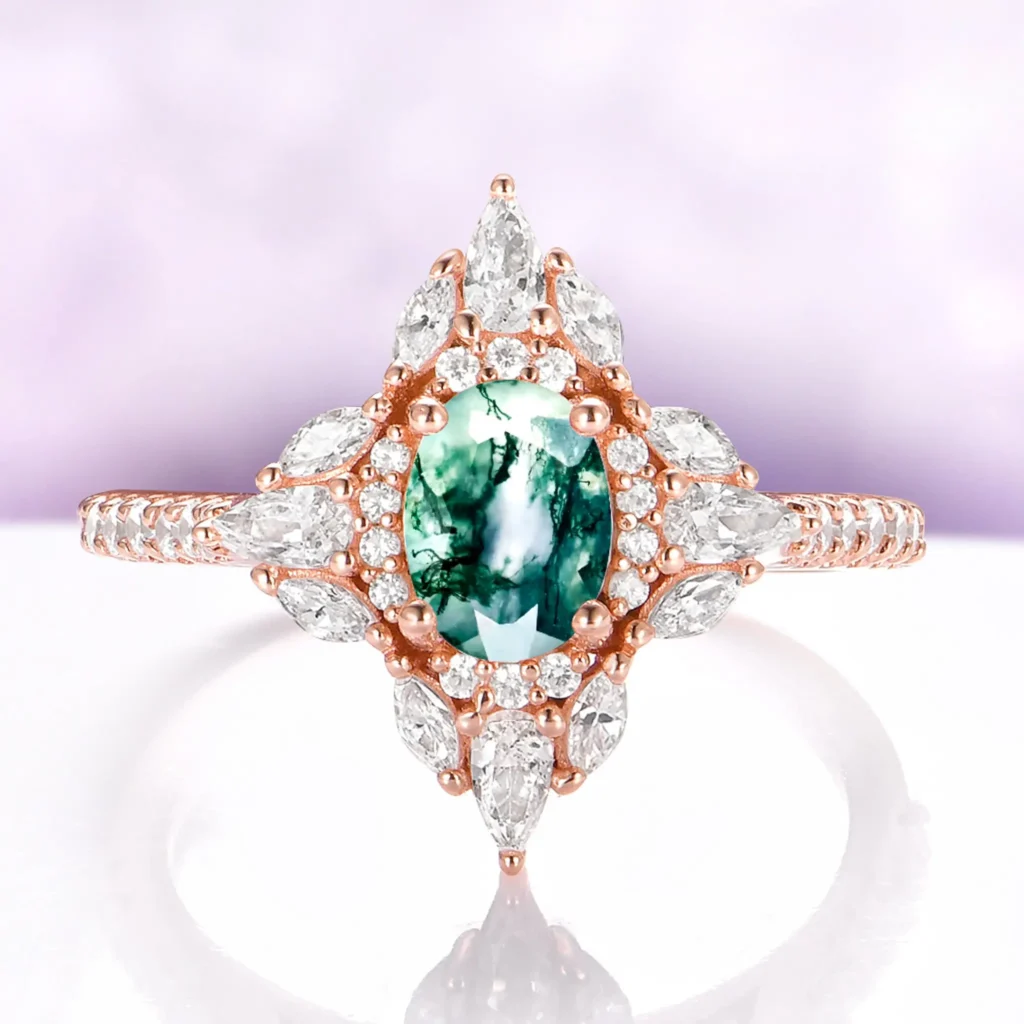
Ask what is moss agate and you will get the same answer in a hundred places: a stone with fossilized moss trapped inside it. It is a lovely story and it is wrong. There is no plant in the stone, there never was, and the truth is more interesting than the myth. What looks like a pressed fern or a winter tree line is mineral, not vegetable. Understanding how those shapes actually formed changes how you look at the stone, and it explains almost everything else about it, from why it is cloudy rather than clear to why it is nearly always cut with a smooth domed top instead of faceted like a diamond.
Chalcedony forms from silica-rich fluid moving through cavities and cracks in rock, very often in volcanic rock where gas bubbles left voids behind. As that fluid cools or loses pressure, dissolved silica comes out of solution and builds up on the cavity walls as countless microscopic quartz fibers packed tightly together. Because the crystals are so small, the result is a dense, waxy solid rather than the clear prisms most people picture when they think of quartz.
The same circulating groundwater carries other dissolved metals, especially iron and manganese. When conditions shift, those metals oxidize and precipitate out too, forming solid mineral deposits inside the still-forming silica. Manganese oxides tend toward black and very dark brown, while iron oxides give the greens, olives, reds, and rust tones. The green that defines moss agate usually comes from iron-bearing minerals in the chlorite or hornblende family, which is why the color sits in that specific mossy, slightly gray-leaning range rather than the clean grass green of an emerald. The whole assembly then sits for a very long time while the surrounding rock erodes, which is why so much of it is eventually collected from riverbeds and gravel deposits.
Dendritic growth is a well-studied physical pattern, and it appears far beyond gemstones. Frost on a window, lightning, river deltas, and the copper deposits that grow inside an electrochemical cell all branch in similar ways. The mechanism is that growth happens fastest at the tips, where fresh material is most available. Once a small protrusion exists, it reaches further into the surrounding fluid than the flat surface behind it does, so it collects more material and grows faster still. Side branches form at intervals along the way, each competing for the same limited supply. The result is a self-similar, fractal-looking structure that thins as it extends.
This is why a moss agate crystal pattern never repeats. The branching depends on tiny local variations in concentration, temperature, and the geometry of the space available, so every stone records a slightly different sequence of accidents. That uniqueness is not marketing language. It is a direct consequence of how the pattern forms, and it is the reason two stones cut from the same nodule can look nothing alike.
Plants branch for a related reason. A tree extends toward light and nutrients, splitting repeatedly to maximize the surface it can reach with the material it has. Dendritic minerals branch to maximize contact with the fluid feeding them. Different systems, same underlying geometry, so our pattern-recognition takes one look at the mineral version and files it under “fern.” The illusion is strengthened by the way the dendrites sit at various depths inside a translucent body, so some appear crisp and near the surface while others fade into the background exactly the way distant foliage does. Human eyes read that depth cue as atmosphere, and the stone starts to look like a landscape.
Because chalcedony is built from countless microscopic fibers rather than one continuous crystal, light entering the stone is scattered at every internal boundary between those fibers. Some light gets through, but it is diffused rather than transmitted cleanly, so you can see a glow and a shadow through a thin slice without being able to read text placed behind it. That is the working definition of translucent. Faceting depends on light entering a stone, bouncing off internal surfaces at precise angles, and exiting as flashes of brilliance. A material that scatters light internally cannot do that, which is why faceting a moss agate gemstone mostly produces a gray, muddled look instead of sparkle.
Cutters therefore treat moss agate as a picture rather than a prism. The dominant approach is the cabochon: a smooth domed top with a flat or gently curved base, polished rather than faceted. The dome magnifies the inclusions slightly and gives the surface a soft, wet-looking sheen. The second common approach is a flat slice, sometimes with shallow facets around the edge or on the crown, which keeps the stone thin enough to backlight and shows the pattern almost like a stained glass panel. Both approaches share one priority: orientation. The cutter has to decide which plane through the rough shows the best arrangement of dendrites, because slicing a nodule the wrong way can cut straight through the most interesting structure and leave a dull face behind. Much of the skill in working this material is choosing where to make the first cut.
Montana is the best known source, and material from the Yellowstone River drainage has been collected and cut for well over a century. India produces large quantities, and Brazil, Uruguay, and Indonesia are also significant sources. Because the nodules survive erosion well, natural moss agate is often gathered from gravels and riverbeds rather than quarried from a single seam.
It is worth separating moss agate from a few things it gets confused with. Tree agate is opaque and white-bodied, with dark dendrites on a solid background, and that opacity is the real distinction rather than the pattern itself. Dendritic agate is essentially the same phenomenon in a colorless or very pale body, where the branching is dark against near-clear chalcedony. Plume agate has softer, feathery inclusions that look more like smoke than branches. And genuinely fossil-bearing stones do exist in the mineral world, but they are a different category entirely and moss agate is not among them.
So, what is moss agate? It is a translucent chalcedony carrying a record of its own chemistry, written in branching oxide dendrites that formed under conditions that will never be repeated in exactly the same way. Various traditions have long associated the stone with growth, new beginnings, and a connection to the natural world, and those associations are worth knowing as beliefs rather than as literal claims about what a mineral can do. The geology needs no embellishment. A stone that looks like a forest without ever having contained one is a genuinely strange and beautiful thing, and knowing the real mechanism makes the illusion better, not smaller.