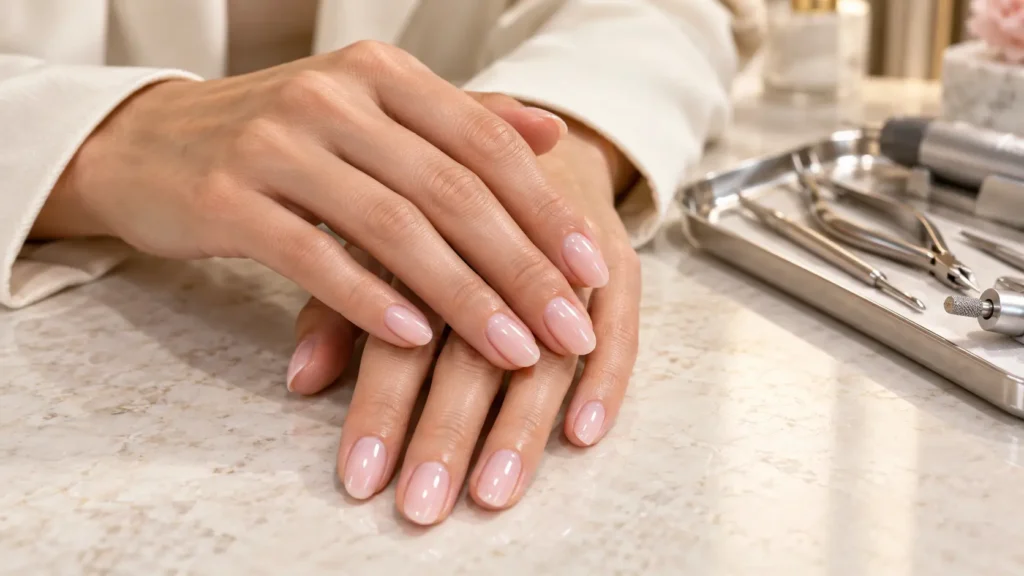
A manicure that chips by day four and one that still looks clean at week four are not using the same process, even when the polish color on top is identical. The difference usually starts underneath the color, at the nail plate itself, long before a topcoat ever gets involved.
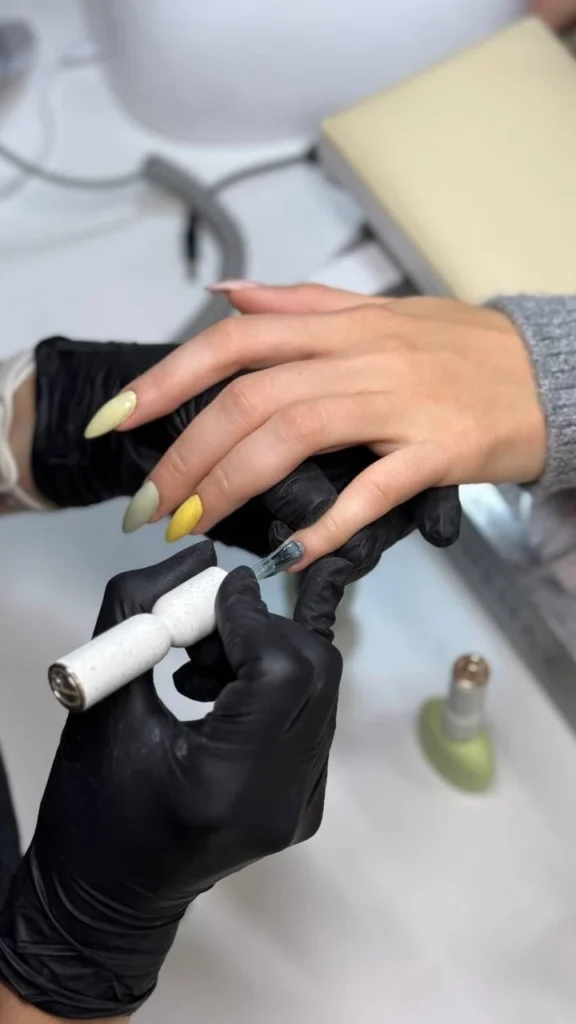
Most manicures start with a soak. Warm water softens the cuticle so it can be pushed back or trimmed by hand. The Russian method skips that step. A rotary e-file, fitted with fine ceramic or diamond bits, lifts dead skin and cuticle tissue off the nail plate while the nail stays completely dry.Working dry changes what a technician can actually see. Softened, waterlogged skin hides small ridges and uneven patches that reappear the moment the nail dries out again. On a dry nail, those same details show up in real time. That visibility is part of why the technique is associated with a cleaner line around the cuticle and a smoother base for whatever comes next, whether that is a bare buff, a builder gel overlay, or color.
Polish and gel rarely fail because the product itself is weak. Most lifting starts at the edges of the nail. A thin ridge of leftover cuticle or oil breaks the seal between the nail and the coating right at that border. Removing that ridge with an e-file, instead of leaving a trace of it behind after a quick trim, gives the base coat a cleaner surface to bond to across the entire nail, not just near the center. That is also where the four-week wear associated with this method actually comes from. It is not a stronger polish formula sitting on top. It is more complete prep underneath it. A structured hard gel overlay, shaped to follow the architecture of the natural nail instead of sitting on top of it like a shell, keeps that clean edge intact as the nail grows out. That edge is usually the first part of a regular manicure to break down.
Two habits make the biggest difference in how long any of this holds:
An e-file is not a forgiving tool in untrained hands. Too much pressure or the wrong bit can thin the nail plate or irritate the surrounding skin. That risk is exactly why studios built around this technique tend to invest heavily in how technicians learn to use it before ever touching a client’s nails. At ELF Nails Lab, every technician goes through an internal training system built by the studio’s founder, a specialist with more than 17 years in the nail industry and a background judging international nail competitions. Testing follows before anyone works independently with clients.
Does the tool used to remove a cuticle matter less than how carefully it is used? For a technique that depends on pressure control and bit selection instead of the product on the shelf, it probably matters more. Two technicians can use the exact same e-file and still get very different results, depending on training alone.
None of this makes the Russian manicure faster than a standard one. The dry, e-file process typically takes longer in the chair than a soak-and-trim manicure, since more of that time is spent shaping the nail plate at a slow, deliberate pace instead of softening the skin around it. What changes is where the time goes: less of it spent waiting for skin to soften, more of it spent on the part of the nail that determines how the manicure ages. A longer appointment is a fair trade for fewer trips back to the salon in between.
For anyone who has watched a fresh manicure lift at the edges within a week, that trade-off, more prep time up front for a longer clean result after, is often the more noticeable difference between one appointment and the next.