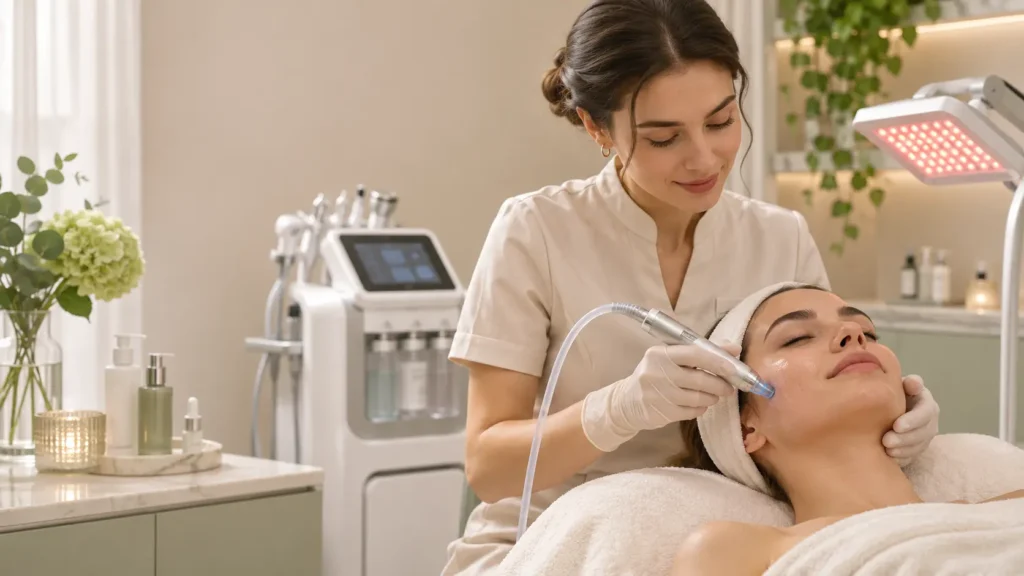
Professional facial treatments have evolved beyond traditional cleansing, steaming, and manual extractions. Today’s beauty professionals can choose from specialized equipment for exfoliation, hydration, light therapy, facial toning, and other skin-focused services.
As treatment options expand, selecting the right technology becomes increasingly important for spas, estheticians, and skincare clinics. Some systems combine several techniques in one session, while others concentrate on a specific treatment approach.
The following seven professional beauty equipment brands illustrate how different technologies are shaping modern facial services. Comparing them can help spa owners, estheticians, and clinic teams weigh different approaches to treatment delivery.
Modern professional facial equipment allows practitioners to customize treatments around individual skin concerns rather than relying on the same routine for every client.
Hydrodermabrasion combines liquid-based exfoliation with suction and solution application, while hydradermabrasion is another commonly used term for similar water-assisted techniques. Oxygen-focused systems take a different approach, incorporating specialized exfoliation and oxygenation-related treatment steps.
Other technologies serve separate purposes. LED phototherapy uses selected wavelengths of light, microcurrent devices apply low-level electrical currents, and ultrasound equipment uses high-frequency vibrations for cleansing or product application.
The growing availability of multifunction facial machines also allows professionals to incorporate several techniques into a structured appointment.
However, these technologies aren’t interchangeable. Their suitability depends on the client’s needs, the practitioner’s training, and the intended application. Understanding those differences makes comparing professional beauty machines much more useful.
Rejuva Fresh supplies professional hydrodermabrasion machines and multifunction facial equipment designed for spas, estheticians, and aesthetic practices. Its HYDRA Perfection MD range combines several treatment functions within a single system, allowing practitioners to build customized facial services.
The equipment incorporates water-assisted exfoliation, suction-based cleansing, and topical solution application. Certain configurations also include ultrasound, radiofrequency, and cooling attachments, creating opportunities to combine different steps within one appointment.
However, the number of functions is only part of the decision. Ease of operation, cleaning procedures, replacement components, and staff training also influence how effectively equipment fits into daily services.
Hydrafacial is an established name in professional facial technology, recognized for its proprietary Vortex-Fusion system.
The company’s Syndeo platform uses a controlled spiral-action handpiece to combine cleansing, exfoliation, extraction, and topical serum infusion. Its closed-loop delivery system is designed to remove surface debris while applying treatment solutions.
One distinguishing feature is its standardized treatment workflow, which allows providers to incorporate different boosters and treatment steps according to client needs. Syndeo also includes digital features intended to support equipment management and treatment-room operations.
An important distinction is that Hydrafacial is a trademarked brand, not a general term for every hydrodermabrasion treatment. Other manufacturers offer water-assisted facial machines, but those systems have their own designs, operating requirements, and product compatibility.
Practitioners considering Hydrafacial should evaluate the treatment protocols, proprietary consumables, staff training, and ongoing operating requirements alongside the equipment itself.
Zemits develops professional beauty equipment with a particular focus on multifunction aesthetic systems and hydrodermabrasion technology.
Its DermeLuxx Pro platform combines HydroDiamond exfoliation, oxygen-serum spraying, and cooling applications. The Verstand HD system expands the treatment possibilities through additional functions, including vacuum extraction, ultrasonic skin scrubbing, and radiofrequency.
These configurations illustrate why multifunction facial machines appeal to beauty businesses seeking flexibility. Rather than maintaining completely separate systems for cleansing, exfoliation, and certain finishing treatments, practitioners can organize several complementary steps around one platform.
Zemits also emphasizes its HydroDiamond approach, which combines diamond-based exfoliation with hydrodermabrasion techniques.
For a spa owner, the main consideration is whether those additional functions support actual client demand. An extensive selection of attachments offers limited value if employees lack the training or appointment time to use them properly.
Consumable requirements, cleaning procedures, technical assistance, and equipment maintenance remain important considerations when comparing Zemits systems with other professional facial equipment.
Candela is known for professional aesthetic technologies, and its Glacē facial platform brings several treatment techniques together in a structured skincare experience.
Glacē combines precision microdermabrasion, hydro-infusion, and dual-mode cupping massage. Its treatment workflow also incorporates finishing options such as LED therapy and skin-renewal accessories.
This combination reflects an important development in professional facial treatments: equipment is increasingly designed around a complete treatment sequence rather than one isolated function.
For example, a practitioner can use exfoliation to address surface buildup, introduce appropriate topical products during the infusion stage, and incorporate massage into the overall experience.
The platform’s adjustable treatment components provide flexibility, although individual settings and steps must suit the client’s skin condition and treatment objectives.
Clinics considering Glacē should examine its consumables, treatment duration, staff training, and maintenance requirements. These operational factors determine how conveniently the system can be incorporated into an existing facial menu.
Geneo approaches professional facial treatments through a combination of exfoliation, oxygenation-related technology, and complementary aesthetic techniques.
Its Geneo X platform brings together OxyGeneo, TriPollar radiofrequency, electrical skin activation, ultrasound, and massage. These technologies can form part of a coordinated facial protocol.
OxyGeneo is central to the brand’s approach. According to Geneo, OxyGeneo combines exfoliation and treatment-specific ingredients with a process intended to encourage the skin’s natural oxygenation response. This differs from systems that concentrate primarily on suction-based cleansing or liquid infusion.
Geneo also uses specialized OxyPods and accompanying formulations to create different treatment options.
For practitioners, the attraction lies in combining several treatment stages within one system. However, individual technologies have different operating principles, so their functions and outcomes cannot be treated as identical.
Professionals evaluating Geneo X should consider the available treatment configurations, product consumables, device instructions, and training needed to deliver the intended services consistently.
Celluma focuses on light-emitting diode (LED) therapy rather than mechanical exfoliation or hydrodermabrasion.
Its professional equipment uses selected combinations of blue, red, and near-infrared wavelengths. The Celluma PRO, for example, offers programs associated with acne, aging skin, and pain management.
Unlike cleansing or extraction systems, LED devices deliver light energy without mechanically removing surface skin cells. This makes them a distinct treatment category that can be incorporated into facial services when appropriate.
Celluma’s flexible panels are designed to conform to treatment areas, providing an alternative to conventional rigid light panels.
When comparing LED light therapy equipment, practitioners should examine wavelength specifications, treatment programs, coverage area, session duration, and manufacturer instructions.
Device indications and regulatory clearances can differ between models and markets. Professionals must also consider contraindications, appropriate protective measures, and whether a particular treatment protocol suits the individual receiving it.
Bio-Therapeutic has a long history in professional skincare technology, particularly microcurrent facial equipment and specialized exfoliation systems.
Its equipment range includes microcurrent devices such as the bt-sculpt GEN2, ultrasonic technology, and Bio-Brasion wet/dry microdermabrasion systems.
Each technology addresses a different part of the facial treatment process.
Microcurrent facial devices use low-level electrical currents within designated treatment protocols. Ultrasonic tools use high-frequency vibrations for applications such as surface cleansing, exfoliation, and product application. Microdermabrasion equipment, meanwhile, focuses on controlled mechanical exfoliation.
These distinctions help practitioners choose equipment according to treatment objectives rather than assuming that all electronic facial tools perform similar functions.
Bio-Therapeutic’s range also demonstrates that professional facial technology doesn’t always require a large multifunction console. Smaller specialized devices can serve particular purposes within an established treatment routine.
The appropriate choice depends on the practitioner’s training, intended treatment steps, client suitability, and equipment maintenance requirements.
Selecting equipment begins with identifying which treatments a business intends to provide.
A spa focused on cleansing, exfoliation, and hydration may benefit from hydrodermabrasion machines. A practice interested in light-based services may instead prioritize LED equipment, while microcurrent and ultrasound tools support other treatment approaches.
Before purchasing, professionals should evaluate several practical factors:
For businesses comparing Hydrafacial alternatives or other professional beauty machines, a demonstration can help clarify treatment workflow, cleaning requirements, and operator usability.
The most suitable equipment is not necessarily the system offering the greatest number of functions. It is the one that supports the services a practice can deliver consistently, appropriately, and efficiently.
Professional facial technology offers numerous ways to expand and refine skincare services, but choosing the right equipment requires more than comparing product features.
Start by identifying the treatment goals, then evaluate the technologies designed to address them. Compare device specifications, maintenance requirements, consumables, and available professional support before making a purchase.
A carefully selected system, combined with appropriate practitioner training, can become a valuable part of a modern facial treatment menu.