Free shipping on all US orders
10% OF OUR PROFIT GOES TO KIDS’N’CULTURE NON-PROFIT ORGANIZATION
Beauty buyers make up their minds fast. They pick up a product, turn it over, feel the weight of the box and decide in a few seconds whether it looks like something worth the price. The formula inside might be excellent, but if the box feels flimsy or generic, the sale gets harder.
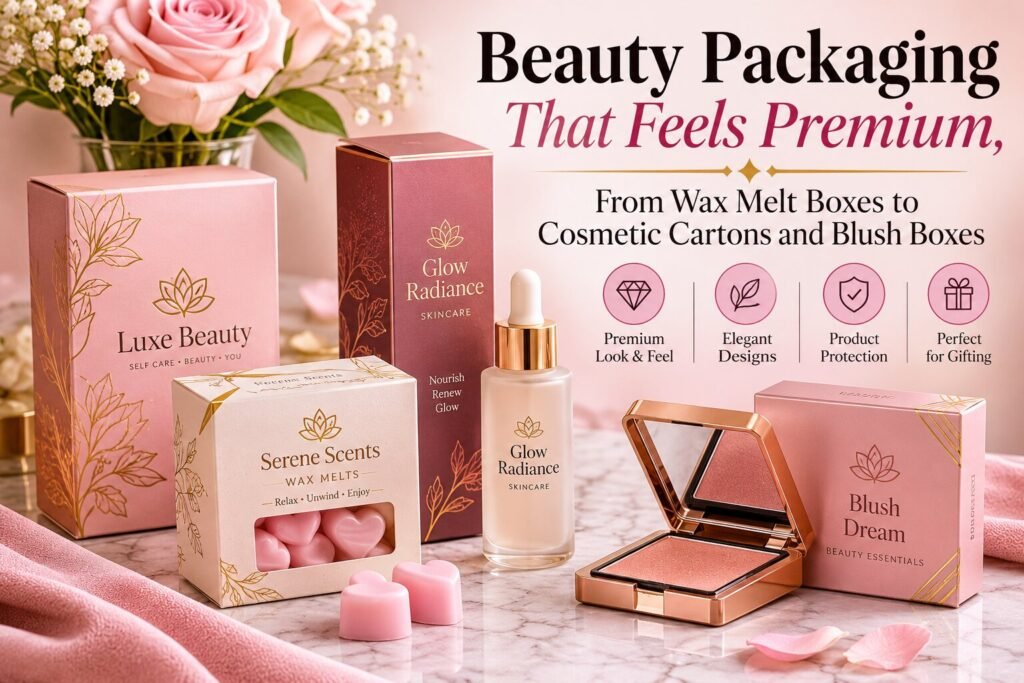
That is why so many indie beauty and home fragrance brands now treat packaging as part of the product, not an afterthought. A premium box does not have to mean gold foil on everything. More often it comes down to the right board, a clean print, a smart insert and a finish that suits the brand. This post walks through three kinds of beauty packaging that show this well, wax melt boxes, cosmetic cartons and blush boxes, and what makes each one feel special.
Premium is a feeling, and it comes from a handful of small details that add up. Customers rarely notice them one by one, but they notice when they are missing.
That last point matters most. Brands that try to use every finishing option at once usually end up with a busy box. Brands that choose one hero detail and execute it well look far more confident.
Wax melts have grown from a niche craft product into a serious category, and the packaging has had to grow up with it. Melts are soft, fragrant and easily scratched, so they need a box that protects the surface and holds in the scent until the customer opens it.
A good wax melt box is usually a small tuck end or sleeve style with a clamshell or tray inside. The box should be sized closely to the clamshell so the melts arrive unbroken, and the board should be thick enough to stop the corners crushing in the mail. Many makers like a window on the front, because the color of the melts is a big part of the appeal. A pastel lavender bar or a deep amber snap bar sells itself when buyers can see it.
There is also a strong sustainability angle in this category, since home fragrance buyers tend to care about what happens to the packaging afterward. Brands looking for ideas can find a helpful overview of custom wax melt boxes in eco-friendly materials, from kraft board to recycled stock with plant-based inks.
Cosmetic cartons are the folding boxes that hold serums, creams, lipsticks, foundations and nearly everything else on a beauty shelf. They have two jobs. They protect the primary container, whether it is a glass dropper bottle or a plastic tube, and they carry the information customers and regulators expect, from ingredients to directions and batch codes.
Cardboard is the workhorse material here. It folds cleanly, prints beautifully and is easy to recycle, which suits clean beauty brands well. Paperboard in a medium weight is enough for most tubes and jars, while glass bottles benefit from a slightly heavier board and a simple insert that stops the bottle from sliding.
The trick with cosmetic cartons is balancing information and design. A carton has limited space, and the back panel fills up quickly once ingredients and warnings are in place. Keep the front panel for the brand name, product name and one short benefit, and move everything else to the sides and back. Brands that order custom cardboard cosmetic packaging often use a consistent layout across the whole range, so a cleanser, a serum and a moisturizer clearly belong together on the shelf even when the colors change.
Here is a simple order of work that keeps carton projects on track.
Blush, bronzer and highlighter come in compacts that are flat, round or square, and often surprisingly heavy for their size. The box around them needs to hold the compact firmly, show off the shade and feel like a small treat to open.
Rigid or semi-rigid boxes with a lift-off lid are a favorite for blush, because they give the opening a sense of occasion. A simple insert with a shaped cavity keeps the compact centered and stops it from rattling. For a lighter, more affordable option, a well-made folding box with a window on the lid lets the shade show through, which helps buyers choose between similar colors on a crowded shelf.
Color matching is the detail that separates good blush packaging from great. If the box uses the shade of the blush inside, the match needs to be closed, or the box will make the product look wrong. Brands that order custom blush boxes usually ask for a printed proof and compare it against the real pan under daylight before signing off.
A few finishing ideas suit blush boxes especially well.
Most beauty brands start with one or two products and grow into a full line. The packaging should be planned for that growth from day one. Decide on a few fixed elements, such as the logo position, the typeface and the finish, and let only one thing change from product to product, usually the color.
Consistency pays off in more than looks. It makes reordering simpler, keeps print costs down and helps customers recognize the brand at a glance, whether they are browsing in a shop or scrolling an online store.
There is a common worry that eco-friendly packaging looks cheap. In practice, kraft board, recycled paperboard and soy-based inks can look very refined when the design is restrained. A single color print on natural kraft, with plenty of empty space, often feels more premium than a crowded glossy box.
Small choices make a difference. Paper inserts instead of plastic, fewer layers of packaging, and boxes sized to the product all reduce waste without hurting the experience. Customers notice, and many will choose a brand partly because the box can go straight into the recycling.
Premium beauty packaging is less about spending more and more about choosing well. Wax melt boxes need protection and a clear view of the color, cosmetic cartons need a clean layout and a snug fit, and blush boxes reward careful color matching and a satisfying opening. Pick one hero detail, keep the range consistent and test every sample with the real product, and the packaging will do its share of the selling.
There are no reviews yet. Be the first one to write one.

A whole world on the tip of a pencil. The story of an artist who proved that true art has no limits and that it is never too late to start all over again.
$130.00 Original price was: $130.00.$65.00Current price is: $65.00.

International fashion icon and symbol of Parisian style, Ines de la Fressange is one of the most famous women in France.

Anastasia Pilepchuk is a Berlin-based artist with Buryat roots. She creates masks and face jewellery inspired by the nature and the culture of her beautiful region.

A whole world on the tip of a pencil. The story of an artist who proved that true art has no limits and that it is never too late to start all over again.