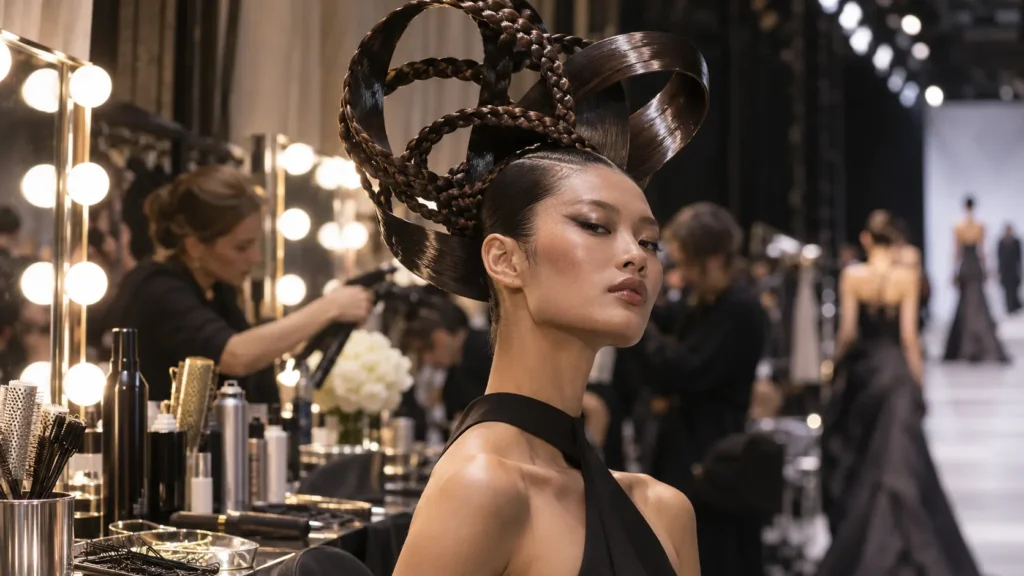
Forty minutes before a show, the hair team is building something that will not exist by dinner. A knot of hair stretched over hidden wire. A wet-looking helmet lacquered flat to the skull. A braid structure that takes two people and a third to hold the mirror. It is sculpture made from a material that grows, wilts, and belongs to somebody who is also wearing the clothes.
The gifts that outlast the party slot into something she already does every day: washing her face, refilling a water bottle, getting into bed. Usually they’re an upgrade on something she’d buy herself and keeps putting off.
A hair look exists for the length of a show and the hour of photographs after it. There is no edition, no vitrine, no conservation report. The only copies are images, and the images belong to photographers rather than to the person who built the thing.
That makes hair design one of the few disciplines in fashion where the work is always a performance and never an object. Set design gets reused. Garments go to archives. The hair is combed out backstage while the next show is already loading in.
Which raises an awkward question about craft. If nothing survives, how does anyone judge the skill?
The answer, mostly, is engineering. A look has to survive forty minutes of walking, hot lights, three costume changes and somebody pulling a sweater over the head of it.
Holding hair in a shape is not a modern ambition.
Researchers at the University of Manchester examined hair from eighteen Egyptian mummies and found that nine of them had been coated in a fat-based styling product, used in life and preserved in death. The study, published in the Journal of Archaeological Science, describes embalmers adapting their method to keep a hairstyle intact.
Three thousand years later the principle is the same and only the polymer has changed. The modern era arrived with the aerosol can, and it arrived fast. Writing in the journal of the Society of Cosmetic Chemists, industry chemists recorded that somewhere between thirty-five and thirty-eight million cans of polyvinylpyrrolidone-based hair spray sold in the United States in 1955 alone.
PVP worked because it dissolves in both water and solvent. It could be sprayed from a volatile base and then washed out at the end of the night, which is precisely what a show look needs.
Early formulas used shellac and were close to unremovable. Anyone building a sculpture that has to vanish has a professional interest in solubility.
Backstage the product table is a tool rack, not a beauty counter.
Gel and wax shape wet hair and then commit. Sprays are the opposite: they fix a shape that is already there, in thin layers, and let the stylist keep adjusting between passes. Hairsprays are the medium that makes a reversible sculpture possible at all.
What differs between them is not really hold. It is how the product behaves on the second and third pass, and whether it brushes out or shatters.
Stylists also pick by distance. A fine mist held at arm’s length sets a surface without weight, which matters when a look has to photograph as hair rather than as product. A heavy spray at close range is for structure you want to feel like plastic, and occasionally that is the brief.
Film-forming polymers, solvent, propellant, fragrance, a little conditioning agent. That is close to the whole recipe.
Cosmetics in the United States do not go through an approval process the way drugs do, and FDA resources on hair products read accordingly: safety notices, labeling rules and warning letters rather than permits. Responsibility for a formula sits with the company selling it.
For a stylist this is less abstract than it sounds. Professional kits get chosen by behavior under heat, by smell in a closed room with forty people in it, and by whether the can clogs halfway through a look.
There is an environmental reason that these products keep being reformulated, and it has nothing to do with marketing.
Solvent has to evaporate for a spray to set, and what evaporates is a volatile organic compound. When California regulators moved on consumer products, they named hair spray as the single largest source of emissions in the group, at 92,000 pounds a day of smog-forming hydrocarbons, and stepped the limit down to 55 percent by weight. It has tightened again since.
Chemists have spent three decades rebuilding hold with less solvent to carry it. The quiet consequence shows up backstage, where modern sprays dry faster and smell less than the cans of twenty years ago.
So the sculpture is temporary by chemistry as well as by circumstance. It is built to come apart, by a stylist who knows it will, in front of an audience that will only ever see the image.
That is not a loss, exactly. Plenty of art is made to end. Ice sculpture, sand mandalas, a plated dish in a kitchen, flowers arranged for a single evening.
But it does change what a portfolio is. A hair artist’s body of work is somebody else’s photographs, cropped by an art director, filed under a designer’s name.
It is the one discipline in the building where success looks like nothing left behind.
Next season they will build another one, out of the same keratin and the same polymer, and wash it out at half past eleven. The craft is in knowing exactly how much structure a thing needs when it only has to stand up for an hour.