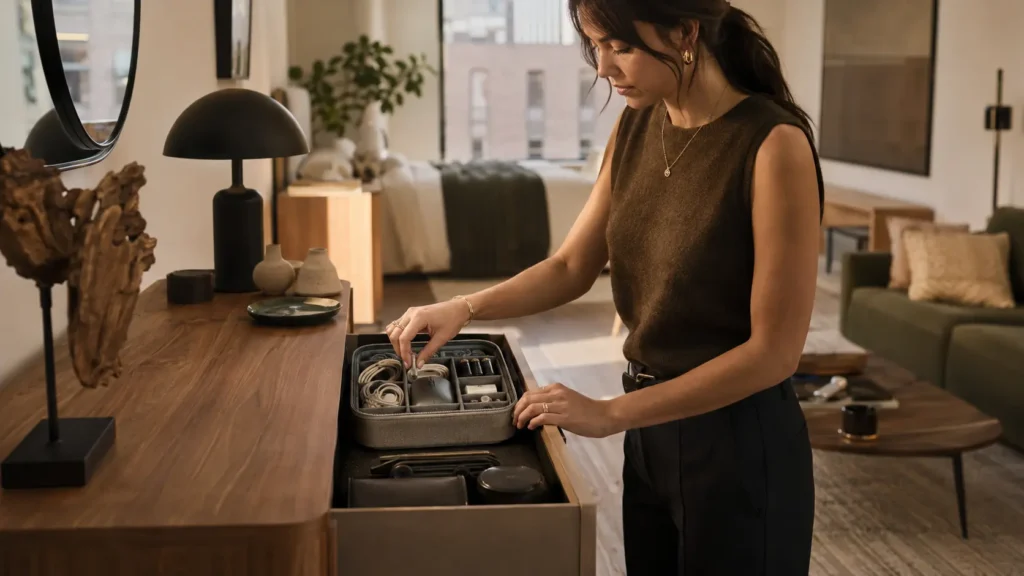
One of the simplest organizational principles is one category, one home. Instead of dividing related belongings between several drawers and rooms, assign one consistent storage location to each group. Depending on the amount of space available, that location could be:
The storage zone does not need to be large. In fact, choosing a container that closely matches the amount of equipment usually makes organization easier because there is less unused space for unrelated objects to accumulate.
Discreet storage is sometimes interpreted as finding the most concealed place possible, but privacy can be much more practical than that. In a shared apartment, it may simply mean keeping personal items separate from communal household belongings. Closed storage also reduces visual clutter, protects smaller objects from accidental damage, and makes it easier to move an entire setup when necessary. Instead of collecting loose items from several surfaces, everything can return to the same designated location. This approach treats privacy as intentional organization rather than secrecy.
The best storage solution depends on what is being organized, how often it is used, and whether the items normally need to travel together.
An oversized bag can create almost as much organizational friction as having no system at all. Small objects disappear into large compartments, and empty space gradually attracts unrelated belongings. A container should provide enough room for the normal setup while remaining compact enough to fit naturally into the available drawer, cabinet, or shelf.
Dividers, internal pockets, elastic loops, and separate sections can help prevent several small accessories from becoming one loose pile. Compartments are especially useful when a setup contains cables, batteries, tools, or other components that are easier to locate when stored separately. They can also reduce contact between objects that could scratch or damage one another.
Regularly handled personal accessories inevitably collect dust and residue. Storage made from wipeable or otherwise easy-to-maintain materials can make routine cleaning more practical. The interior matters as much as the exterior. A visually attractive organizer is less useful if its lining is difficult to clean or traps debris.
Some personal categories introduce another consideration: aroma. In these situations, visual privacy alone may not be sufficient. Odor-resistant or smell-resistant storage can be relevant when a product or accessory has a noticeable scent and the user wants to reduce how much that aroma spreads through drawers, bags, or shared living areas. Storage should still follow any applicable product-specific instructions.
A basic pouch works well when the goal is simply to collect a few lightweight objects in one place. Once a setup contains multiple components, however, additional organization features can become useful. A compartment organizer keeps separate items from mixing together. Smell-resistant storage addresses odor control when that is a relevant requirement. A compact carry bag can make sense when the same collection of belongings regularly moves between different storage locations. The appropriate choice depends on the problem being solved. Someone dealing primarily with visual clutter does not necessarily need the same solution as someone prioritizing compartmentalization or odor management.
A practical test for deciding what belongs together is simple: if several items are normally needed at the same time, store them in the same place. Travel documents can stay with frequently used travel chargers. Skincare products can remain with grooming tools. Camera batteries belong near the camera rather than in an unrelated electronics drawer. Hobby accessories follow the same logic. This reduces searching and makes cleanup faster because the entire category has a defined destination. It also discourages duplicate purchases caused by forgetting where individual items were stored.
Compact electronics need more deliberate storage than ordinary accessories. Batteries and rechargeable devices should have a consistent location rather than being mixed randomly with keys, coins, loose metal objects, or miscellaneous drawer contents. Manufacturer guidance for storage and charging should be followed, and devices should be checked periodically for visible damage or other signs that they may require replacement. Chargers can also be kept with the devices they support so they do not become another category of loose household clutter.
Organization becomes easier to maintain when storage feels intentional rather than temporary. Neutral colors, closed containers, and compact organizers can blend naturally into existing furniture instead of making a room look like it contains another collection of equipment. Separating everyday items from occasional-use accessories also helps. Frequently needed belongings can occupy the most accessible compartment, while less commonly used pieces can stay deeper in the same storage system. A consistent color palette and similar container styles can further reduce visual noise, particularly in small bedrooms, studios, and shared living spaces.
Buying additional boxes rarely solves clutter if there is no logic behind what goes into them. A better starting point is identifying which items are used together, which require dedicated or private storage, and which genuinely need to remain within easy reach. Once those categories are clear, a single appropriately sized organizer can often replace several scattered drawers, loose pouches, and improvised storage spots. The result is not simply a tidier room, but a personal setup that is easier to maintain, easier to move, and less intrusive in a limited living space.