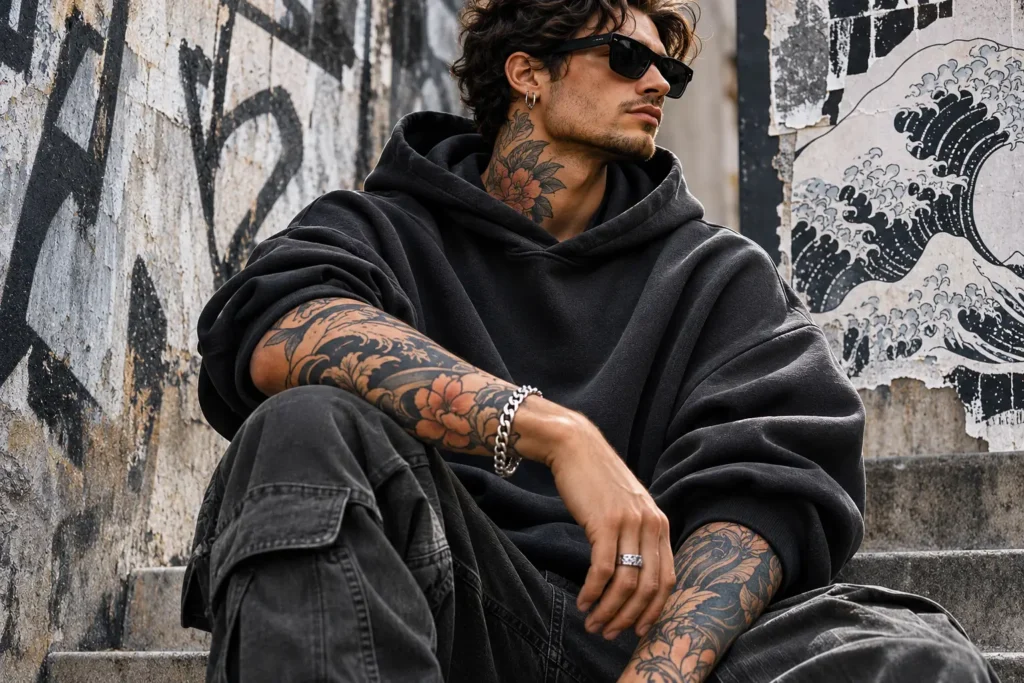
Building a cohesive look where your tattoos and your streetwear read as one personal style comes down to three practical decisions: matching the visual weight of your ink to the fabric weight and structure of your everyday wardrobe, choosing a tattoo aesthetic anchored in timeless form rather than passing garment trends, and mapping body placement to the exact collars, sleeve lengths, and silhouettes you wear most. Ink functions as the base layer of every outfit. When line weight, contrast, and anatomical placement work with your clothing cuts, even a plain heavyweight tee looks intentional.
Streetwear draws from workwear, skate culture, athletic gear, and technical outerwear, and each lane shares visual DNA with specific tattoo traditions. Knowing how line thickness, negative space, and saturation interact with textiles helps you pair what is on your skin with what hangs in your closet.
Blackwork relies on heavy black saturation, crisp geometric boundaries, or bold abstract forms that use bare skin as active negative space. Because it strips away color gradients in favor of stark silhouette and contrast, blackwork naturally mirrors technical outerwear, monochrome layering, cargo pants, and structured heavyweight hoodies. Against matte black nylon, charcoal fleece, or crisp white cotton, solid black ink reads like an architectural extension of the garment’s seams.
Defined by thick black outlines, deep shading, and a disciplined palette of saturated primary colors, American traditional ink was built to stay legible from across a room. That durability echoes heritage workwear staples: canvas chore coats, raw denim, waffle-knit thermals, and vintage athletic sweatshirts. Because traditional motifs carry strong visual punch and warm color accents, they hold their own against rugged fabrics like heavy twill, corduroy, and distressed leather.
Fine line tattooing uses single-needle precision, soft gray shading, and airy composition to create understated detail that rewards a closer look rather than shouting from a distance. In a streetwear rotation built around elevated basics—pleated wide-leg trousers, knit polos, clean leather sneakers, and tonal neutral layering—fine line work adds texture without disrupting a quiet silhouette. Where heavy black blocks might overpower a lightweight camp-collar shirt, delicate linework functions like subtle jewelry.
Japanese-inspired tattooing prioritizes anatomical flow, using waves, clouds, wind bars, and botanical or mythological motifs to wrap smoothly around muscle groups. Unlike isolated patchwork pieces that sit like separate stickers on the skin, a cohesive sleeve or torso panel follows the body’s natural movement. That continuous motion pairs effortlessly with relaxed, draped silhouettes—oversized open button-downs, wide-cut denim, collarless jackets, and layered hems that reveal shifting sections of the artwork as you move.
Streetwear and street art grew up on the same city blocks, making graffiti-influenced character art, surreal cartoons, and dynamic marker-style shading a natural match for expressive wardrobes. Choosing lettering-free illustrative work gives you the kinetic energy, exaggerated proportions, and bold contour lines of street art without creating visual clutter against graphic tees. When your ink focuses on expressive figures, abstract motion, or stylized objects rather than words, it never competes with screen-printed chest graphics.
Clothing rotations evolve every few years. You might shift from loud prints and baggy skate pants into muted earth tones and structured outerwear, then pivot back toward relaxed athletic cuts. Picking a tattoo style that still feels like you through every closet transition means separating seasonal hype from the core visual qualities you wear year after year.
Use these decision cues to choose an aesthetic that ages well with your wardrobe:
Streetwear plays with proportion through dropped shoulders, wide sleeves, thick ribbed collars, and boxy hems. Because a tattoo is framed or partially covered by fabric edges most of the day, planning placement around how your clothes hang prevents good ink from being awkwardly split by a seam.
Fitted t-shirts stop mid-bicep, whereas boxy streetwear tees use dropped shoulder seams and wider sleeves that reach the elbow crease. Placing a standalone tattoo in the center of the outer bicep means a drop-shoulder tee will slice right across the bottom of the design. Anchoring work on the lower forearm or building a cohesive half-sleeve ensures the artwork looks complete whether you are wearing an oversized tee or rolling up the cuffs of a heavyweight hoodie.
Collar height dictates how upper-torso ink functions in a daily outfit. Heavyweight streetwear tees usually feature thick, high-sitting ribbed collars that cover the collarbones completely. Chest and collarbone placements stay hidden under a standard crewneck, making that zone ideal when you want ink that only appears with an open camp-collar shirt or an unzipped jacket. For everyday visibility in hoodies and crewnecks, the lower forearm and outer wrist do far more visual work than the upper chest.
Garment volume changes how tattoo scale reads from a few steps away. Oversized hoodies and wide-leg cargos create large blocks of fabric; when a tiny, low-contrast tattoo peeks out from a wide cuff, the mismatch in scale can make it look lost. Baggy silhouettes pair best with bolder contrast or placements that fill the visible limb area, such as the lower forearm or the calf above crew socks. Conversely, cropped boxy tops lift slightly as you move, turning side-torso or lower-rib ink into a subtle detail above mid-rise pants. Wear your favorite shirt cut to your consultation to test where hems land in motion, and ask your tattoo artist directly if you have any questions about your skin.