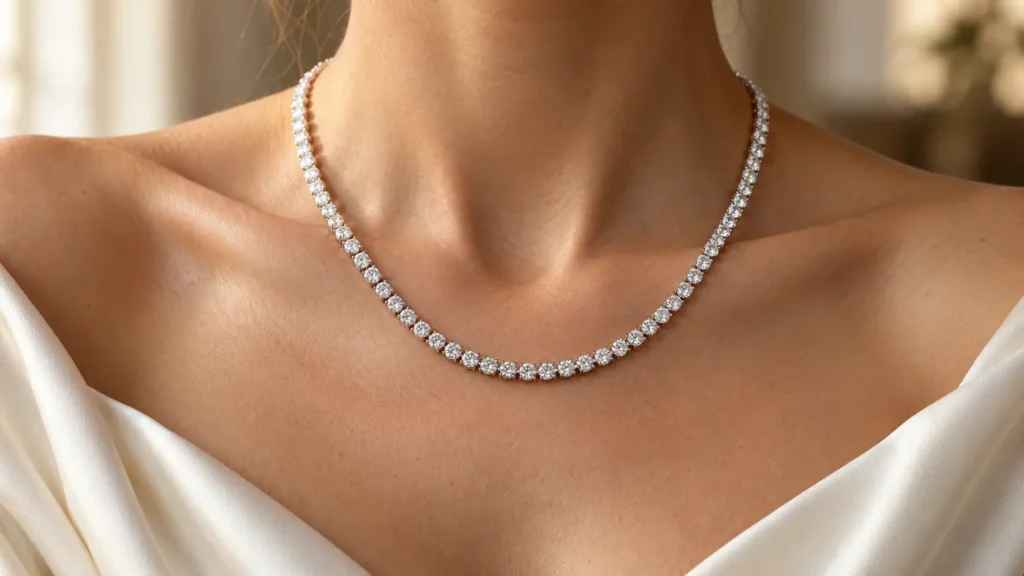
Some jewellery follows trends, and some outlasts them. A line of sparkling stones around the neck is one of the simplest ideas in jewellery, and it has stayed fashionable for a very long time. It works with a T-shirt and with an evening dress, and it looks as good on a first wear as it does years later. This article explains what makes a tennis necklace special, what to look for when choosing one and how to style and care for it so it stays beautiful.
The tennis necklace has stayed popular for several reasons. It is versatile. A slim line of stones suits casual clothes and formal ones, so you can wear it every day or save it for occasions. It layers well with other necklaces, or it can be worn on its own as a quiet statement. It is flattering. The continuous line follows the neckline and draws the eye gently, and it suits many face shapes and necklines. It does not date. The design is simple enough to stay in style, so a well-made piece can be worn for decades and passed on.
The stones are the heart of the necklace, so they deserve close attention. Diamonds are the classic choice. They can be natural or lab-grown. Both are real diamonds, but they differ in origin and usually in price, so ask which you are being shown and what grading information is available. Coloured gemstones, such as sapphires, rubies or emeralds, give a different look and a pop of colour. Some are softer than diamonds, so ask how they will wear over time. Matching is important. In a tennis necklace, every stone should look like it belongs to the same family. Look at how consistent the colour, clarity and brilliance are along the whole line, because one dull or tinted stone stands out in a continuous design. Stone size changes the character. Smaller stones give a delicate, fine look that suits everyday wear, while larger ones make a bolder statement. Choose a size that suits your style and how you plan to wear it.
How the stones are held affects both the look and the safety of the necklace. Claw settings hold each stone with small metal points and let in a lot of light, which makes the stones sparkle. Bezel settings wrap a thin rim of metal around each stone, which is a little more protective and gives a sleek, modern look. Check the construction. The links should be smooth and flexible, and the stones should sit evenly and securely. A well-made necklace feels soft against the skin and lies flat without kinking.
The clasp is easy to overlook, but it protects your necklace. Look for a secure clasp and a safety catch or second lock for extra peace of mind. A necklace with many valuable stones is worth protecting, and a strong clasp helps prevent it from being lost.
The metal changes the look of the necklace. White gold and platinum have a cool, bright tone that makes diamonds look crisp and clear. Yellow gold gives a warm, classic look and can make a slight warmth in a stone less noticeable. Rose gold is soft and romantic. Think about the jewellery you already wear. Matching your metals makes pieces look consistent, though mixing metals is also a style choice. If you have sensitive skin, ask the jeweller about the metal’s composition.
Length affects how the necklace sits and how it looks with your clothes. A shorter length sits close to the base of the neck and is easy to wear every day. A slightly longer length drapes lower and suits more open necklines. A longer one can layer with other pieces. Try on different lengths if you can. The right length depends on your neck, your neckline and the way you like to wear jewellery. A jeweller can often adjust or make a necklace to your length.
A tennis necklace is easy to wear. For everyday style, wear it with a plain top, a shirt or a knit. It adds a touch of polish without effort. For evening, pair it with a V-neck, a strapless dress or an open collar, where the line of stones can show. Keep other jewellery simple so the necklace stays the focus.For layering, combine it with a fine chain or a pendant at a different length. Keep the styles complementary, and avoid too many pieces competing.
A little care keeps it sparkling. Clean it gently with warm water, a few drops of mild soap and a soft brush, then rinse and dry with a soft cloth. Avoid harsh chemicals, which can harm some metals and stones. Take it off when you swim, exercise or do cleaning or heavy work. Put it on after perfume, lotion and hairspray, since these can dull the stones. Store it flat or in a soft pouch so it does not tangle or scratch other pieces. Have it checked regularly. Ask a jeweller to inspect the claws, links and clasp from time to time, because a small repair now can prevent a loss later.
A few questions help you choose well. Ask about the stones, including whether they are natural or lab-grown and what grading information is available. Ask how well matched the stones are. Ask about the metal, the setting and the clasp, and what safety features are included. Ask about care, resizing and repairs, and what happens if something needs fixing. Ask whether the piece can be made to a custom length or design.
A tennis necklace is a simple line of stones that suits almost every occasion. Choose well-matched stones, a secure setting and clasp and a metal and length that suit you. Care for it, and it will stay beautiful for years. Choose stones that match, check the clasp and keep up regular checks, and you will enjoy the necklace for a long time.
It is a slim, flexible necklace made of a continuous line of matching stones, usually diamonds, set one after another, so the sparkle runs all the way around.
Think about your neckline and how you like to wear jewellery. A shorter length sits close to the neck, while a longer one drapes lower. Try a few lengths if you can.
Clean it gently with mild soapy water and a soft brush; take it off for swimming and heavy work, store it flat, and have the claws and clasp checked regularly.