Our series exploring the architecture of Paris continues with professional architect Anna Bakhlina, who takes us inside some of the city’s most remarkable landmarks. In each episode, Anna shares the history, architectural significance, and fascinating stories behind Paris’s iconic buildings.
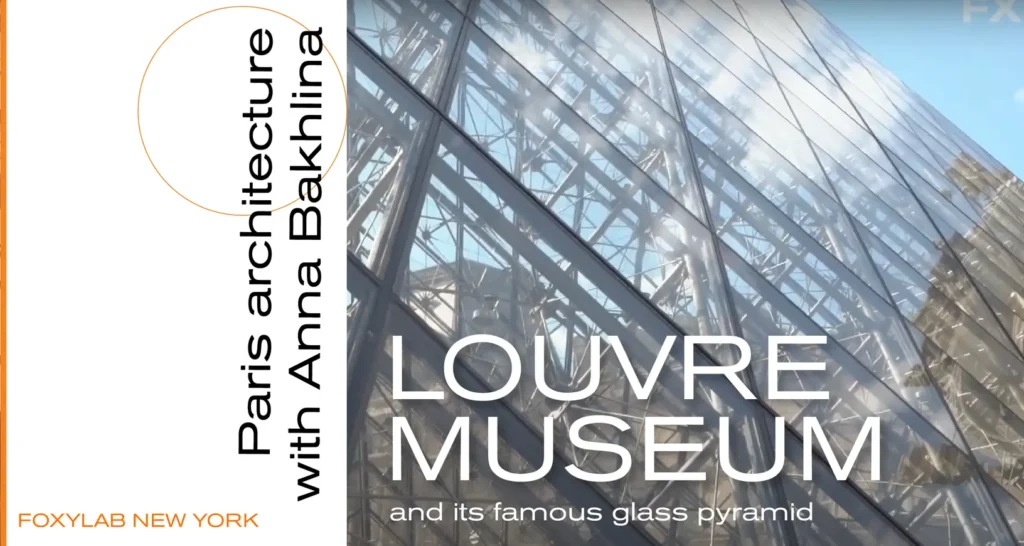
In this episode, we explore the Louvre Museum the world’s most-visited museum and one of the most recognizable landmarks in Paris. Originally built as a medieval fortress between the late 12th and early 13th centuries, the Louvre evolved over hundreds of years through multiple expansions and architectural transformations. What was once a royal palace eventually became one of the world’s greatest museums, home to an extraordinary collection of art spanning thousands of years.
One of the Louvre’s most famous transformations took place during the 1980s under French President François Mitterrand. As part of his ambitious Grand Louvre Project, Mitterrand selected renowned Chinese-American architect I.M. Pei to design the now-famous Louvre Pyramid and the vast underground entrance beneath it.
The project also required relocating the French Ministry of Finance from the Louvre’s North Wing, allowing nearly the entire historic palace to become dedicated museum space. Like many bold architectural projects including the Pompidou Centre the pyramid initially sparked public controversy and intense debate before receiving final approval. The outdoor pyramid and surrounding courtyards were inaugurated in 1988, while the underground lobby officially opened in 1989.
Today, the glass pyramid at the Louvre is one of the defining symbols of Paris. Every year, millions of visitors gather in the Cour Napoléon to admire its striking geometry and photograph one of the world’s most recognizable architectural landmarks. But beyond its iconic appearance lies a fascinating story of innovation, controversy, and visionary design.
Anna Bakhlina has worked as an independent architect in Paris since 2020. She began her career as a researcher and professional volunteer in the international township of Auroville, South India, where she explored sustainable architecture and urban development.
Before establishing her independent practice, Anna was a key member of the design team at the Garage Museum of Contemporary Art, collaborating with SANAA, the Tokyo-based architecture studio awarded the 2010 Pritzker Prize. In 2016, while working as a lead architect at Atelier Tekuto, she contributed to the Boltun Project, which later received the Japan Concrete Institute Award for the country’s Best Concrete Building of the Year (2018).
Over the past several years, Anna has also collaborated with buro LOCAL on a joint Franco-Russian research project focused on innovative housing solutions, bringing together international perspectives on architecture, urban planning, and residential design.