There are a few places in Paris that almost don’t need an introduction, and the Louvre is one of them. Even people who have never been to France know the glass pyramid, the endless palace façades, or the fact that the Mona Lisa lives somewhere inside. But the Louvre is much more than a museum, it’s a former royal palace, a piece of French history, and the place where you can move from medieval stone foundations to ancient Egyptian objects and giant Romantic paintings in one space.
That’s also what makes it overwhelming. The Louvre is enormous, crowded, and full of things you could easily miss if you only follow the usual “top 10 things to see” route. So if you’re planning a visit – or simply want to understand why this museum matters so much – it helps to know a little more than where the Mona Lisa is hanging.
The Louvre Museum is France’s national museum and one of the most famous museums in the world. It sits in the middle of Paris, along the Right Bank of the Seine, and has a collection that stretches from ancient civilizations to 19th-century European painting. That’s the official answer. The more useful answer is that the Louvre is several places layered into one. It began as a fortress, became a royal palace, and eventually turned into a public museum after the French Revolution. You feel that history as soon as you walk through it. It doesn’t feel like a neutral gallery space built simply to display art. It feels like a building that has lived many lives.
One of the reasons the Louvre feels so different from other museums is that it wasn’t originally built to be one. Its history is long, messy, royal, political, and very Parisian.
Long before it was a museum, the Louvre was a fortress. In the late 12th century, King Philip II Augustus ordered it built as part of Paris’s defenses. At that point, the city was much smaller, and the Louvre stood closer to the edge of medieval Paris than it does today. The original structure had tower and defensive walls. It was practical rather than beautiful. it also meant to protect, not impress. Parts of that fortress still survive underground, and seeing them is one of the most interesting parts of visiting the museum. It’s a strange and very grounding reminder that before the crowds and the pyramid, the Louvre was a military building.
The shift from fortress to palace began in the 16th century under Francis I, who had a much more refined vision for the site. He was a patron of the arts and reshaped the Louvre into a residence of a king. From there, the Louvre kept expanding. Different monarchs added wings, courtyards, staircases, galleries, and decorative façades. It gradually became one of the main royal residences of France, though the building was never finished in a single coherent moment.
The French Revolution changed the Louvre’s purpose completely. In 1793, the former royal palace opened as a public museum. That mattered symbolically as much as culturally. A place once tied to monarchy became a place for the public. The early museum looked very different from the Louvre we know now, but the idea behind it was already in place: art and cultural treasures would no longer belong only to kings, collectors, or aristocrats. They would become part of the national inheritance.
Fast-forward to the 20th century, and the Louvre had become one of the most important museums in the world. Visitor numbers were growing, the layout was complicated, and the museum needed a serious rethink.
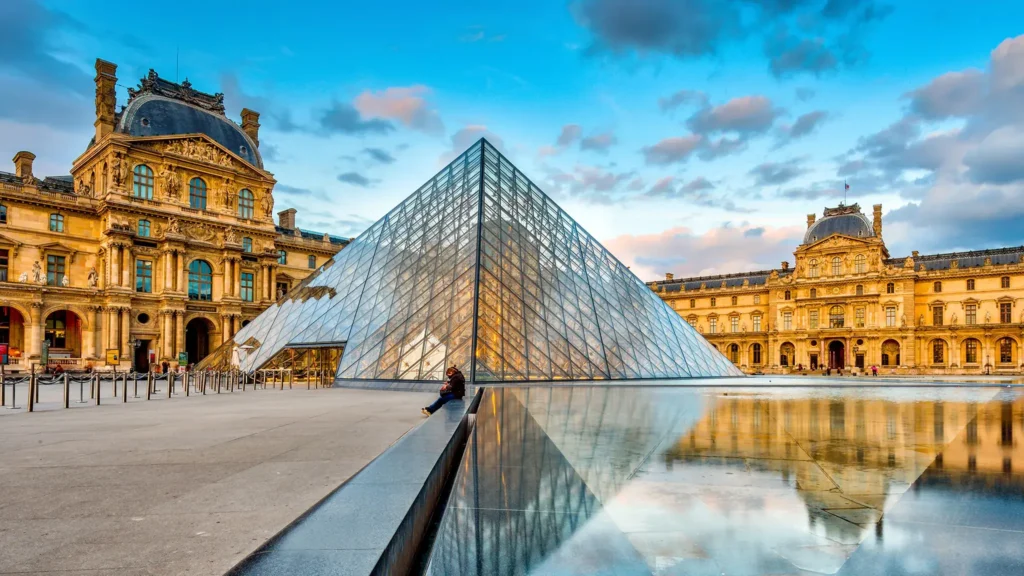
That rethink came in the 1980s with the Grand Louvre Project, launched under President François Mitterrand. The project modernized the museum, expanded its exhibition spaces, and introduced the feature that would become its contemporary symbol: the glass pyramid in the center of the Cour Napoléon.
There are certain landmarks that have become so tied to a city’s image that it’s hard to imagine them being controversial. The Louvre Pyramid is one of them. Today it feels completely natural in the courtyard, but when it was first proposed, people were not universally charmed.
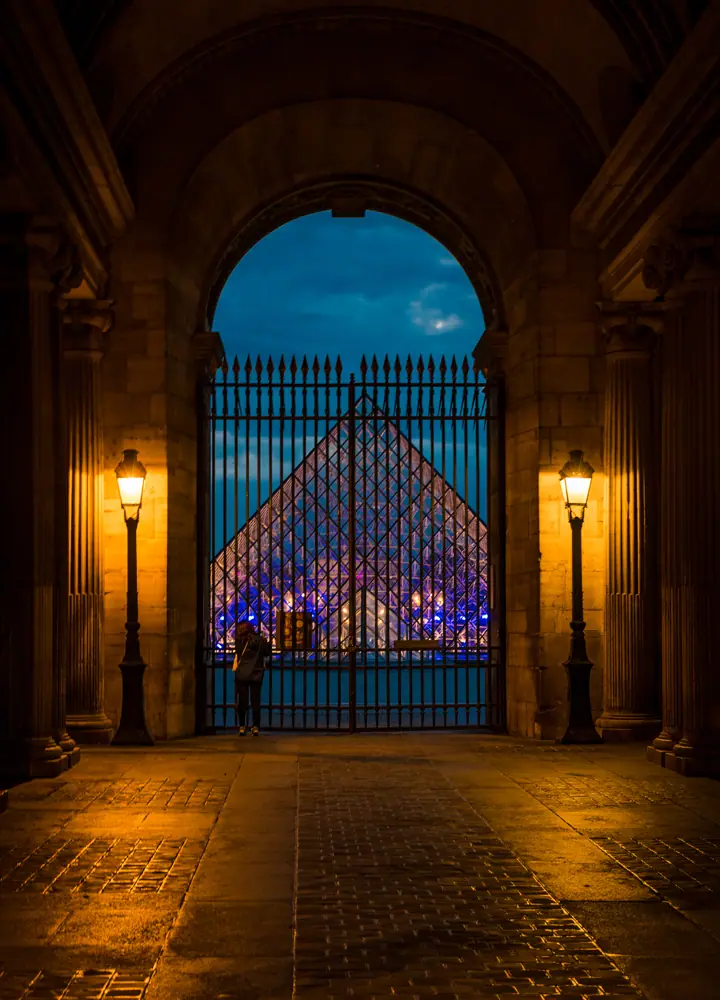
The pyramid was designed by I. M. Pei, the Chinese-American architect, chose to rethink the Louvre’s entrance and circulation. It opened in 1989 as part of the Grand Louvre Project and was designed to solve a practical problem: how to bring huge numbers of visitors into the museum more efficiently. Pei’s answer was to create a large underground reception space beneath a glass pyramid that would act as the museum’s central entrance.
At the time, critics thought the pyramid was too modern, too stark, too disconnected from the classical architecture around it. Some saw it as a provocation. And yet now it’s hard to imagine the Louvre without it. The contrast is exactly why it works.
The pyramid doesn’t try to blend in. That’s the point. It sets up a conversation between the old Louvre and the modern one: monarchy and republic, stone and glass, history and reinvention. It also makes the museum easier to navigate, which may not sound romantic, but matters a lot when you’re dealing with one of the most visited museums in the world.
Trying to “see the Louvre” in one visit is a good way to exhaust yourself. The museum’s collection is huge, and it makes more sense to think of it in sections.
The paintings collection is where many visitors start, especially if they’ve come for the big names. This is where you’ll find Leonardo da Vinci, Raphael, Titian, Veronese, David, Delacroix, and a long list of other artists who shaped European art history.
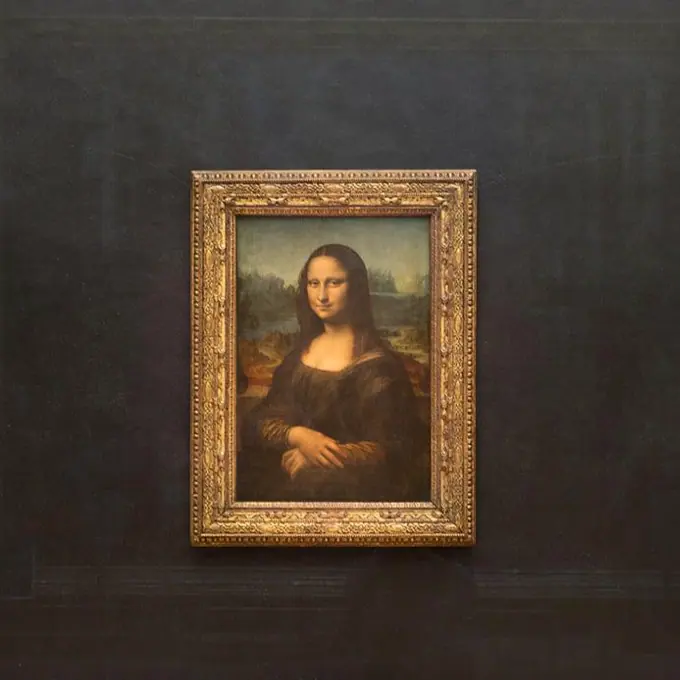
Yes, the Mona Lisa is here. But so are monumental French paintings, religious works, portraits, battle scenes, and rooms full of pieces that tend to get ignored because everyone is rushing toward one famous smile.
The sculpture galleries are among the most rewarding spaces in the Louvre. Some are dramatic and formal, others quieter and easier to linger in. You’ll find everything from medieval funerary sculpture to neoclassical marble figures, and some of the museum’s most recognizable works live in this department.
The Egyptian collection is one of the Louvre’s strongest. It includes statues, sarcophagi, jewelry, funerary objects, papyrus fragments, and everyday items that make ancient life feel less abstract. If you’re visiting with kids, this is often one of the easiest sections to keep their attention.
This department includes some of the Louvre’s most famous works, especially the Venus de Milo and the Winged Victory of Samothrace. It’s one of those parts of the museum where you suddenly remember just how much of Western art history is built on looking back at the ancient world.
If you like interiors, objects, furniture, and the visual language of luxury, don’t skip decorative arts. This part of the Louvre is full of things that tell you how people lived, entertained, displayed status, and decorated power.
The Islamic Art department is one of the museum’s most beautiful spaces. It sits beneath a contemporary canopy in the Visconti Courtyard and includes ceramics, manuscripts, textiles, carved objects, and metalwork from across the Islamic world. It’s also often calmer than the museum’s blockbuster rooms, which makes it a good place to slow down.
This is one of the Louvre’s more specialized departments, and not always the one casual visitors prioritize, but it’s a reminder that the museum’s depth goes far beyond the works everyone photographs.
You could make a very long list here, but a few works have become almost inseparable from the Louvre itself.
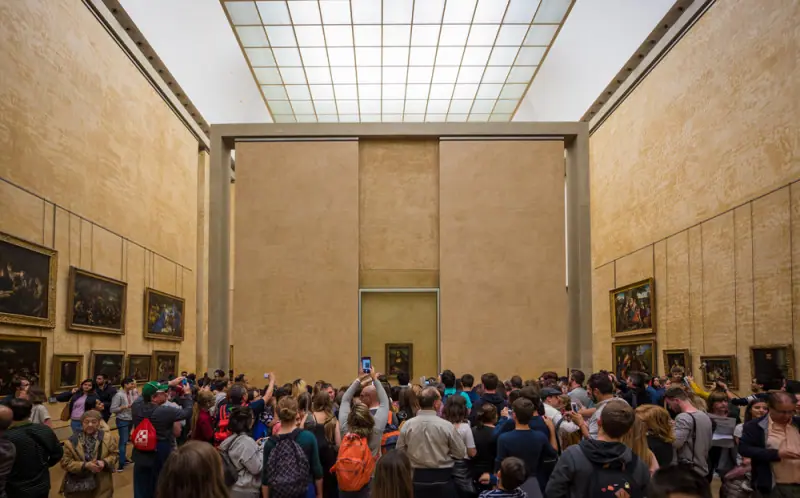
The Mona Lisa is the obvious one. It’s also the work that creates the biggest disconnect between expectation and reality. The painting itself is smaller than many people imagine, and seeing it often means standing in a crowded room full of phones held in the air. But it’s still worth seeing.
The Venus de Milo is one of the Louvre’s great stars, and unlike the Mona Lisa, it tends to feel more immediately rewarding in person. The missing arms somehow add to its aura rather than taking away from it.
If I had to choose one work in the Louvre that consistently lives up to the hype, it might be the Winged Victory of Samothrace. It’s displayed at the top of a staircase in a way that makes it feel almost cinematic. You see it before you reach it, and it has that rare ability to stop a room.
Delacroix’s Liberty Leading the People is one of those paintings that has escaped the museum and entered the broader visual imagination. Even if you don’t know the title, you’ve probably seen it before. In person, it has much more energy and physical scale than reproductions suggest.
The Coronation of Napoleon by Jacques-Louis David is enormous, theatrical, and full of political performance. It’s one of those works where standing in front of it helps you understand how painting functioned as image-making long before modern media existed.
The Raft of the Medusa is one of the most emotionally intense paintings in the Louvre. It’s dark, dramatic, and unsettling in a way that still feels contemporary. If you have any interest in Romantic painting, it’s essential.
Even if you didn’t care about art at all, the Louvre would still be worth seeing for the building alone.
The Louvre’s architecture reflects centuries of additions and redesigns, but much of what visitors notice now comes from the French Renaissance and later classical periods. There’s symmetry, ornament, rhythm, and a kind of royal theatricality to the façades and interiors.
The museum’s courtyards are part of the experience, not just the space you pass through on the way inside. The Cour Napoléon is the most famous because of the pyramid, but the surrounding façades are just as impressive. The scale of the Louvre only really hits you once you stand outside and see how far the palace extends.
Inside, the Louvre can feel beautiful and confusing at the same time. Some rooms are intimate, some are monumental, and some feel like they belong more to a palace than to a museum. That’s part of its charm, but it’s also why planning your route matters.
The Louvre is divided into three main wings: Denon, Sully, and Richelieu. If you know that before you arrive, you’re already in better shape than a lot of first-time visitors.
The Denon Wing is where many of the biggest crowd magnets are located, including the Mona Lisa and the Winged Victory of Samothrace. It’s the busiest part of the museum, and if you’re doing a first-time highlights visit, you’ll almost certainly spend time here.
The Sully Wing is where you’ll find the medieval Louvre remains and a large part of the antiquities collections. It’s a good wing for people who are interested in the building’s earlier life, not just the headline masterpieces.
The Richelieu Wing is often a little calmer and, in my opinion, one of the most satisfying parts of the museum. It includes decorative arts, sculpture, and the Napoleon III Apartments.
The Louvre matters for more than its fame or the sheer size of its collection. It’s a museum deeply tied to French history, but also one that shaped how the modern world thinks about art institutions.
Because the Louvre was once a royal palace, it doesn’t feel separate from history it’s part of it. The museum reflects centuries of French political and cultural life, from monarchy and revolution to the idea of art becoming part of a nation’s shared heritage rather than something reserved for the elite.
The Louvre also helped define the model of the grand museum itself. It influenced how collections are displayed, how certain works become cultural icons, and how museums are used not just to preserve art, but to tell bigger stories about identity, power, and history.
This is the part where strategy matters. The Louvre is much more enjoyable if you go in with a plan.
The museum is located on Rue de Rivoli in the 1st arrondissement, close to the Seine, the Tuileries, and Palais Royal. The easiest Métro stop is Palais Royal–Musée du Louvre. It’s one of the easiest major museums in Paris to build a day around because so much is within walking distance.
The Louvre is generally open every day except Tuesday. It usually opens at 9 a.m. and closes at 6 p.m. on most days, with late openings until 9 p.m. on Wednesday and Friday. As always in Paris, check the official museum site before going, especially around holidays or special events.
The Louvre uses timed-entry tickets, and booking ahead is the smart move, especially in spring, summer, and holiday periods. If you show up without a reservation during a busy week, you may still get in, but it’s not the kind of gamble I’d personally recommend taking.
The busiest areas are predictable. The Mona Lisa room is crowded almost all the time, and the central routes through Denon get packed quickly.
If it’s your first visit and you don’t know much about the collection, a guided tour can be genuinely useful. If you prefer wandering on your own, the audio guide is a good compromise. The key is not trying to absorb the Louvre blindly.
There’s no perfect Louvre itinerary, but there are some works and spaces that make sense to prioritize.
If you’re short on time, the classic Louvre highlights are:
If you want the Louvre to feel more memorable and less like a crowd exercise, go beyond the obvious. Some of the most rewarding parts of the museum are the ones people don’t sprint toward:
The Louvre can work surprisingly well with children if you don’t overdo it. Egyptian antiquities, dramatic sculptures, and a short “treasure hunt” approach tend to go over better than trying to drag kids through four hours of painting rooms.
The Louvre is widely considered the largest art museum in the world by exhibition space, and walking through it, that feels believable very quickly.
The Mona Lisa is protected behind glass and heavily monitored, which is hardly surprising given its fame.
One of the best surprises in the museum is the underground section where you can see the remains of the original fortress. It changes the way you think about the building.
The Louvre attracts millions of visitors every year, which explains both its global status and its crowds.
One of the nice things about the Louvre is that it sits in the middle of a very walkable part of Paris.
The Tuileries Garden is right next door and makes a perfect post-museum decompression stop, especially if you need air and a coffee after several hours inside.
A short walk will take you to the Seine and the Pont des Arts, which is especially nice in the late afternoon.
If you still have energy for more art, the Musée d’Orsay is the obvious next museum, especially if you prefer Impressionism and late 19th-century painting.
Depending on how much walking you’re up for, you can continue toward Notre-Dame and the Île de la Cité and turn the Louvre into part of a full central Paris day.
The Louvre is one of those places that can be both overrated and absolutely worth it at the same time. Yes, it’s crowded. Yes, some rooms feel chaotic. Yes, people often reduce it to a selfie with the Mona Lisa. But none of that changes the fact that it’s an extraordinary museum. What stays with you isn’t usually just one famous painting. It’s the scale of the palace, the feeling of moving through centuries of history, the shock of turning a corner and finding a room you hadn’t planned on loving. The Louvre works best when you stop treating it like a checklist and let it be what it is: huge, imperfect, beautiful, and impossible to fully absorb in one visit.
And maybe that’s part of the reason people keep going back.
The Louvre Museum is famous for its world-renowned art collection, including the Mona Lisa, the Venus de Milo, and the Winged Victory of Samothrace. It’s also known for its history as a former royal palace and for the glass pyramid in its main courtyard.
The Louvre began as a medieval fortress in the late 12th century under King Philip II. It later became a royal palace and officially opened as a public museum in 1793.
The Louvre is owned by the French state and operates as France’s national museum.
The most famous painting in the Louvre is Leonardo da Vinci’s *Mona Lisa*.
Before it became a museum, the Louvre was first a fortress and later a royal palace.
Yes. Even with the crowds, it’s worth visiting. The Louvre is one of the most important museums in the world, and even a partial visit can be memorable.
No, not really. You can see the highlights in a day, but not the entire museum in any meaningful way. It’s much better to focus on a few key areas than to rush through everything.
If it’s your first visit and you don’t know much about the collection, a guided tour can be genuinely useful. If you prefer wandering on your own, the audio guide is a good compromise. The key is not trying to absorb the Louvre blindly. The Louvre began as a medieval fortress in the late 12th century under King Philip II. It later became a royal palace and officially opened as a public museum in 1793.